
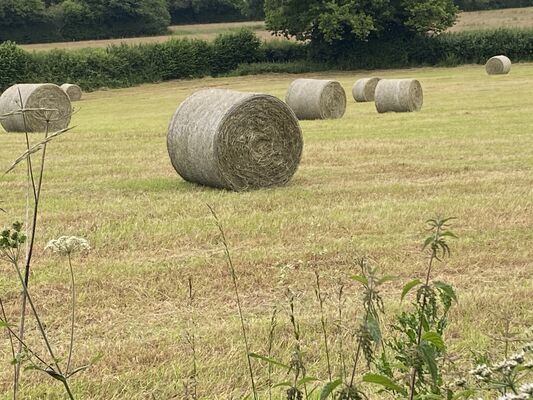
We're lucky enough to look out over open fields here in rural Worcestershire, and at this time of year, this view is everywhere you turn. Tractors, combines, hay balers, the whole soundtrack of the countryside getting on with its work. I took this photo recently, one of those scenes so familiar to us locally that it's easy to walk past it without really looking. I stopped and looked.
Farmers know, through generations of experience, that planting, nurturing and harvesting produces a result. Some years it's good. Some years it's poor. But they keep doing the things necessary to keep the business going, season after season, because that's what the business is for: continuity, not exit.
It struck me, watching this happen yet again this year, that it's rarely in a farmer's mind that they might be building the business in order to sell it. The more common ambition is to pass it on, a legacy carried forward to the next generation, the way the field itself has been worked for generations before.
That's a very different way of building a business than building one to be sold.
Most family businesses are built the same way. Generation after generation, the focus is on running the thing well, on keeping it going, on passing it on. Selling it is rarely part of the original design. Until, one day, it is.
And that's where the difficulty often begins.
So many family businesses now find themselves in exactly this corner: built for continuity, but facing a future where the next generation doesn't want it, and where selling has quietly become the only realistic option. If that's the case, the business often needs to be run differently, structured differently, prepared differently, than it ever was when the plan was simply to keep going.
The hay gets baled every year, rain or shine, good year or bad. That rhythm, reliable and unspectacular, is exactly what makes a farm work as a farm. But it isn't, on its own, what makes a business saleable. Those are two different kinds of strength, and knowing which one you're actually building is worth working out long before the question of selling arrives.
Peter
Built for the Long Run: Why So Many Family Businesses Aren't Actually Built to Be Sold
This week I wrote about the hay bales dotting the fields behind our home, and what struck me watching another harvest come and go: farmers rarely build their businesses with a sale in mind. They build them to keep going, season after season, and to pass on. That distinction, between building to continue and building to sell, turns out to be one of the most overlooked issues in family business today.This sounds like a virtue, and in many ways it is.
A business built for continuity tends to develop real strengths: deep relationships with customers and suppliers, a strong culture, institutional knowledge that lives in long-serving people rather than in manuals, a genuine sense of purpose beyond simply maximising short-term value. These are the qualities that let a family business survive recessions, market shifts, and the ordinary difficulties of trading for decades.
But none of those strengths, on their own, make a business saleable. In fact, several of them can actively work against a sale.
The legacy mindset and its blind spot
When a business is built with the assumption that it will be passed on, certain decisions get made differently than they would if a sale were always the intended destination. Profits get reinvested rather than extracted, because the horizon is generational, not transactional. Roles get built around specific people's strengths rather than documented as transferable processes. Decision-making authority concentrates in the founder, because there was never a pressing need to formalise it elsewhere.All of this works perfectly well, right up until the point where the next generation doesn't want the business, or can't be relied upon to run it, and the only realistic path forward is a sale to an outsider. At that point, every one of those legacy-minded decisions becomes a liability. The buyer wants to see processes, not personalities. They want to see a business that would survive the founder's departure intact, rather than one that is, in practice, inseparable from them.
The corner so many families now find themselves in
This is precisely the corner an increasing number of family businesses are sitting in. Built across one, two, sometimes three generations with continuity as the goal, they now face a next generation who, for entirely legitimate reasons of their own, don't want to take over.Which leaves the founder facing a question their own parents and grandparents likely never had to ask: if not the next generation, then who? And if the answer is a sale, what does it actually take to make a business that was built for legacy attractive to someone who has no interest in legacy at all, only in value, structure, and a viable future without the family involved?
What changes when sale becomes the plan
Preparing a legacy-built business for sale is not simply a matter of tidying up the accounts a year or two before a transaction. It typically requires a genuine shift in how the business operates, often starting years in advance.It means documenting processes that have always lived in people's heads. It means building a management structure that doesn't depend entirely on the founder's daily involvement. It means being honest about which parts of the business exist because they're genuinely profitable, and which exist because they always have, family tradition rather than commercial logic.
It also means, often most importantly, an honest conversation within the family about which kind of business this actually is.
Is this a business we're trying to keep going for as long as that remains realistic?
Or is this a business we are, in fact, now building to sell, in which case decisions need to start being made with that destination in mind, starting now, not in the final year before completion?
Family businesses built for continuity have real and valuable strengths. But recognising, honestly and in good time, whether continuity or sale is the actual destination, and building accordingly, makes an enormous difference to how that destination is eventually reached.
peter@familybusinessman.com