
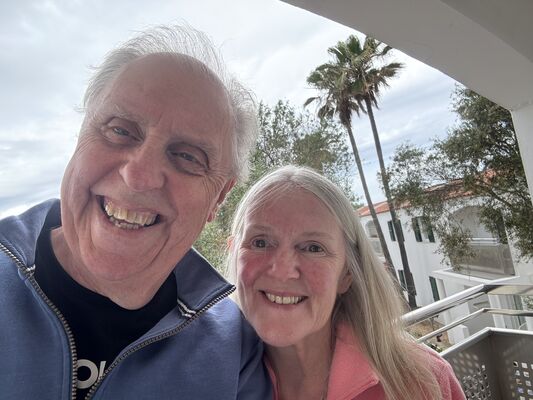
This photo was taken on holiday, somewhere warm, somewhere we had absolutely no business feeling guilty about being.
And yet, old habits...
Even sitting there in the sun, some part of me was doing the thing I always do: half-thinking about the business, wondering how things were ticking along without me, ready to feel that familiar twinge of needing to check in.
Except this time, something was different.
The day-to-day of the business was being properly looked after. Not covered for. Not muddled through. Properly looked after, by the next generation, who had, in no uncertain terms, told us to clear off and take some time out, because we’d earned it.
Because we needed it.
They led. We didn’t have to.
And here’s the thing I keep coming back to: they were right.
Not just right that we needed the break, right in how they handled everything while we were away. Right in the decisions they made. Right in trusting themselves enough to tell us, their parents, to step back.
That’s not a small thing.
In family businesses, the handover of leadership is talked about constantly as a structural event: a date on a calendar, a change of title, a signing of papers. But the real transition isn’t structural.
It’s the moment a parent realises, properly and without reservation, that the next generation doesn’t need rescuing. That they can be told to relax. That the business is, genuinely, in good hands.
I’ve spent years helping families plan for that moment on paper.
Org charts, responsibility matrices, phased handover timelines. All useful. None of them capture what it actually feels like when it happens, which is something closer to relief than triumph.
A quiet, unexpected lightness.
We sat in the sun. The business carried on without us. And for possibly the first time in a very long while, that felt entirely as it should.
Being Told to Clear Off: What Genuine Leadership Transition Actually Feels Like
This week I wrote about a holiday photo of Anny and me, relaxed in the sun, because the next generation had told us, in no uncertain terms, to clear off and take a proper break. It’s a small story, but it captures something about leadership transition that plans and timelines rarely manage to convey: what it actually feels like when it works.All of it matters. None of it tells you what successful transition feels like from the inside, for the person stepping back.
The gap between planning and feeling
I have worked with founders who had immaculate succession plans on paper, every responsibility mapped, every milestone agreed, every legal document signed, who nonetheless found the actual experience of stepping back agonising.The plan worked. The feeling didn’t follow.
This is because leadership transition isn’t really a structural event. It’s an identity event.
For most founders, the business has been the primary lens through which they understand themselves for decades.
A plan can transfer authority. It cannot, on its own, transfer the founder’s sense of who they are once that authority is gone.
What actually signals successful transition
In my experience, the clearest signal that a leadership transition has genuinely succeeded isn’t found in the org chart. It’s found in small, almost throwaway moments, much like the one I described this week.A founder being told by the next generation to take a proper holiday, and meaning it. A founder receiving that instruction and actually being able to relax, rather than spending the holiday secretly checking emails and bracing for a crisis call.
That moment only happens when two things are simultaneously true.
First, the next generation has genuinely demonstrated, through real decisions handled well, that they can be trusted with the business.
Second, and this is the part most plans miss entirely, the founder has done their own internal work to separate their sense of worth from their operational involvement in the business.
Why founders resist stepping back, even when they want to
Many founders genuinely want to step back. And yet, when the moment arrives, something holds them in place.Often what’s holding them isn’t the business at all. It’s the fear of what’s left once the business role is gone.
Status, purpose, the structure that organises their days, the feeling of being needed: all of these are quietly tied up in continued involvement, and stepping back threatens all of them simultaneously.
What helped, in this case
What made the difference, in the story I told this week, wasn’t a piece of paper.It was trust that had been built gradually, through real decisions, over real time, until it reached the point where the next generation felt confident enough to say, plainly, ‘go and relax, we’ve got this,’ and where I was able to actually believe them.
That kind of trust cannot be manufactured quickly or imposed through a governance document. It has to be built, decision by decision, often over years, with the founder gradually loosening their grip and the next generation gradually proving themselves capable of holding what’s released.
That’s not something a succession plan can promise. But it is, in my experience, the truest sign that the transition has actually worked.
peter@familybusinessman.com